


 25/05/2025
When we think about data entry, we usually picture repetitive, time-consuming work — the kind that drains teams and eats up hours. But combining Robotic Process Automation (RPA) and Artificial Intelligence (AI) has genuinely changed that picture for many businesses. Suddenly, things that used to take a day are done in minutes. And by outsourcing these technologies, companies are skipping the trial-and-error phase and going straight to results. It’s not just about speed — it’s about transforming old habits into smarter systems.
Take logistics, invoices, and e-invoice collection as examples. These aren’t just "back office" chores anymore. They're now front and center in discussions about cost, accuracy, and agility. Let’s break that down.
How Data Entry Automation Has Evolved
If you’ve worked with enterprise data systems over the past decade, you’ve probably seen how things have changed. RPA and AI are at the core of that evolution. RPA bots are great for handling structured, rule-based tasks — filling forms, moving files, updating databases. But when you add AI into the mix, that’s when the real magic happens. Suddenly, machines can read messy invoices, pick up on patterns, and even predict what to do next.
This isn't just theory — it's what’s happening in real companies. One logistics provider we worked with needed to handle big seasonal shipping spikes. With outsourced RPA, they scaled their data operations almost overnight, without hiring extra IT staff or buying more servers.
Why Outsourcing RPA Makes Sense
Let’s be honest: building automation in-house sounds great until you run into budget limits, hiring delays, or security compliance headaches. That’s where outsourcing shines. Providers who specialize in RPA and AI often bring ready-to-go tools, tested frameworks, and experience across industries.
Security and compliance? Also covered. The best providers don’t just automate; they bake in audit trails, encryption, and industry-specific regulations. In finance and healthcare, for instance, that kind of trust is essential. Plus, the rollout is fast. Some outsourced e-invoicing systems go live in under 12 weeks. Compare that to the 6–12 months it might take an in-house team to do the same.
Case Study 1: Logistics Shipment Tracing
When a logistics company came to us with a repetitive, time-consuming challenge, we saw an opportunity to streamline operations and boost efficiency through automation.
The Challenge
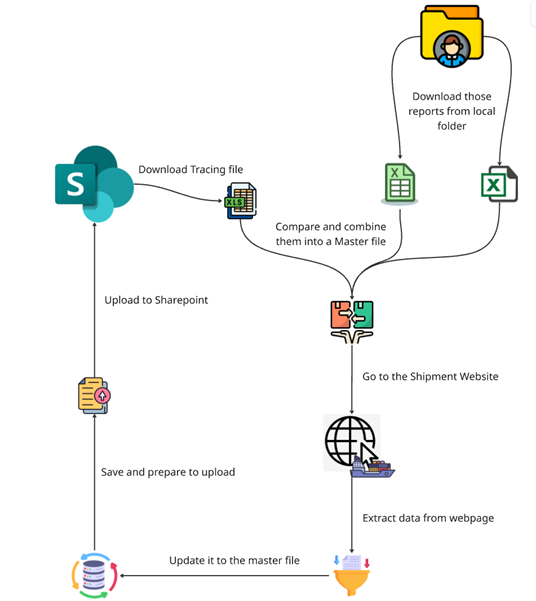
The client’s team was spending countless hours each week manually consolidating multiple data into a single report. After that, they had to access a logistics website, input each shipment number, collect status information, and update the master report manually. This tedious process was not only time-intensive but also prone to human error.
They needed a solution that could:
- Merge data from multiple sources into one central file
- Automatically access a logistics tracking website
- Extract specific shipment status fields
- Update the consolidated master report in real-time
The Solution
We built an end-to-end automated workflow using Microsoft Power Automate and web automation tools. Here's what we did:
- Developed a bot to automatically scan and consolidate data from various sources
- Used web automation to visit the logistics tracking site and retrieve shipment details
- Integrated an auto captcha solver to handle any login barriers smoothly
- Updated the final master report with accurate, real-time data — no human input required
The Results
The impact was immediate and impressive:
- 80% reduction in processing time
- Drastic decrease in manual errors
- Over 20,000 work hours saved in just the first year
Technologies Used
- Microsoft Power Automate
- Web Automation Tools
- Auto Captcha Solver
Case Study 2: Invoice Data Process
Manual data entry might seem harmless until it starts consuming hours of your team's time every week. That was exactly the case for one of our logistics clients, who was stuck entering invoice details into a logistics app, form by form, day after day.
The Challenge
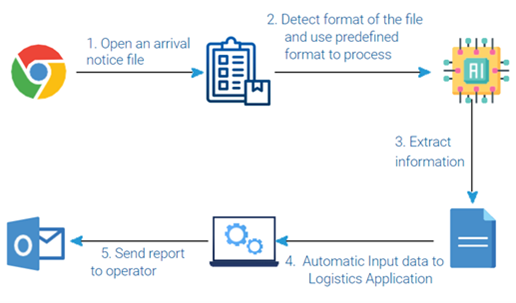
The client relied on staff to manually read invoice documents and enter data into their logistics application. This form-filling task was not only repetitive and boring, but it also left room for human error and ate into time that could’ve been spent on higher-value work.
Their goal is to automate the entire invoice entry process using Microsoft Power Automate, and make use of AI/OCR technology to extract text from scanned or digital invoices.
The Solution
We implemented an intelligent automation flow with the following features:
- AI-powered OCR (Optical Character Recognition) to scan and extract invoice data
- Seamless integration with the client’s logistics app via Microsoft Power Automate
- Auto-population of required fields with zero manual input
This solution eliminated the need for staff to manually handle forms — the bot did all the heavy lifting.
The Results
The outcomes were transformative:
- 90% reduction in processing time
- Employees were freed from tedious, repetitive form-filling
- Teams now have more time to review data, solve real problems, and boost productivity
Technologies Used
- Microsoft Power Automate
- Microsoft AI/OCR
Case Study 3: E-Invoice Collector
For many finance departments, managing invoices is a time-consuming and error-prone task — especially when documents arrive from multiple sources, in different formats, and via various channels. One finance team came to us with a clear goal: streamline the entire invoice handling process from start to finish.
The Challenge
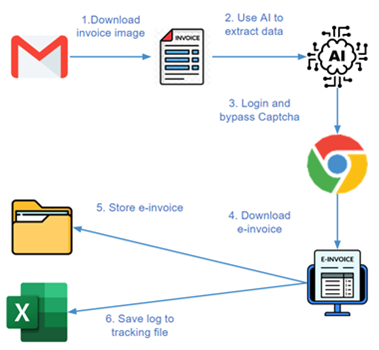
The finance department was responsible for collecting and processing thousands of invoices each month — arriving via email and other online platforms. Manually downloading, organizing, and extracting data from each file was not only tedious but also slowed down essential processes like:
- Tracking expenditures
- Preparing financial statements
- Ensuring audit readiness
The team needed an intelligent, end-to-end automation solution that could:
- Retrieve invoice files (PDF, images, etc.) from multiple sources
- Automatically extract invoice data
- Organize and store the e-invoices securely for future reporting
The Solution
We built a robust automation system using a suite of Microsoft technologies, including:
- Microsoft Power Automate for orchestrating workflows
- Microsoft AI and OCR tools for reading and extracting key invoice data
- Web automation for logging into platforms and retrieving files
- Auto Captcha Solver to bypass verification steps smoothly
The entire process — from collecting invoices to storing and organizing them — was now handled with limited manual intervention.
The Results
The results were game-changing for the finance team:
- 90% reduction in processing time
- Invoices were downloaded, read, and categorized automatically
- Employees could focus on review, analysis, and auditing, rather than administration
- Improved accuracy and faster access to financial data for reporting and decision-making
Technologies Used
- Microsoft Power Automate
- Microsoft AI / OCR
- Web Automation
- Auto Captcha Solver
Conclusion: Moving Toward Smarter, Self-Running Operations
What we’re seeing with RPA and AI — especially when outsourced to experts — isn’t just a tech upgrade. It’s a shift in how businesses think about work. From logistics to invoice handling, intelligent automation is doing more than just saving time and cutting costs. It’s unlocking faster decisions, cleaner data, and more agile operations across the board.
Looking ahead, technologies like generative AI and edge computing will only push this transformation further. The gap between what humans and machines can do is shrinking fast. Companies that start embracing smart outsourcing now aren’t just keeping up — they’re setting the stage to lead in a world where business processes can optimize themselves.
This isn't just about automating data entry. It’s about reimagining how value is created in a digital-first world.

Table Of Content
Start your project today!
Share:


