23/06/2023
The landscape of Robotic Process Automation (RPA) has evolved significantly over the past few years, showing remarkable growth and widespread adoption across various industries. As businesses increasingly recognize the benefits of automation, the RPA market has experienced substantial expansion. This article provides an overview of the key trends and future expectations for the RPA market from 2021 to 2023, drawing insights from industry surveys and research reports.
Key Findings on RPA Adoption
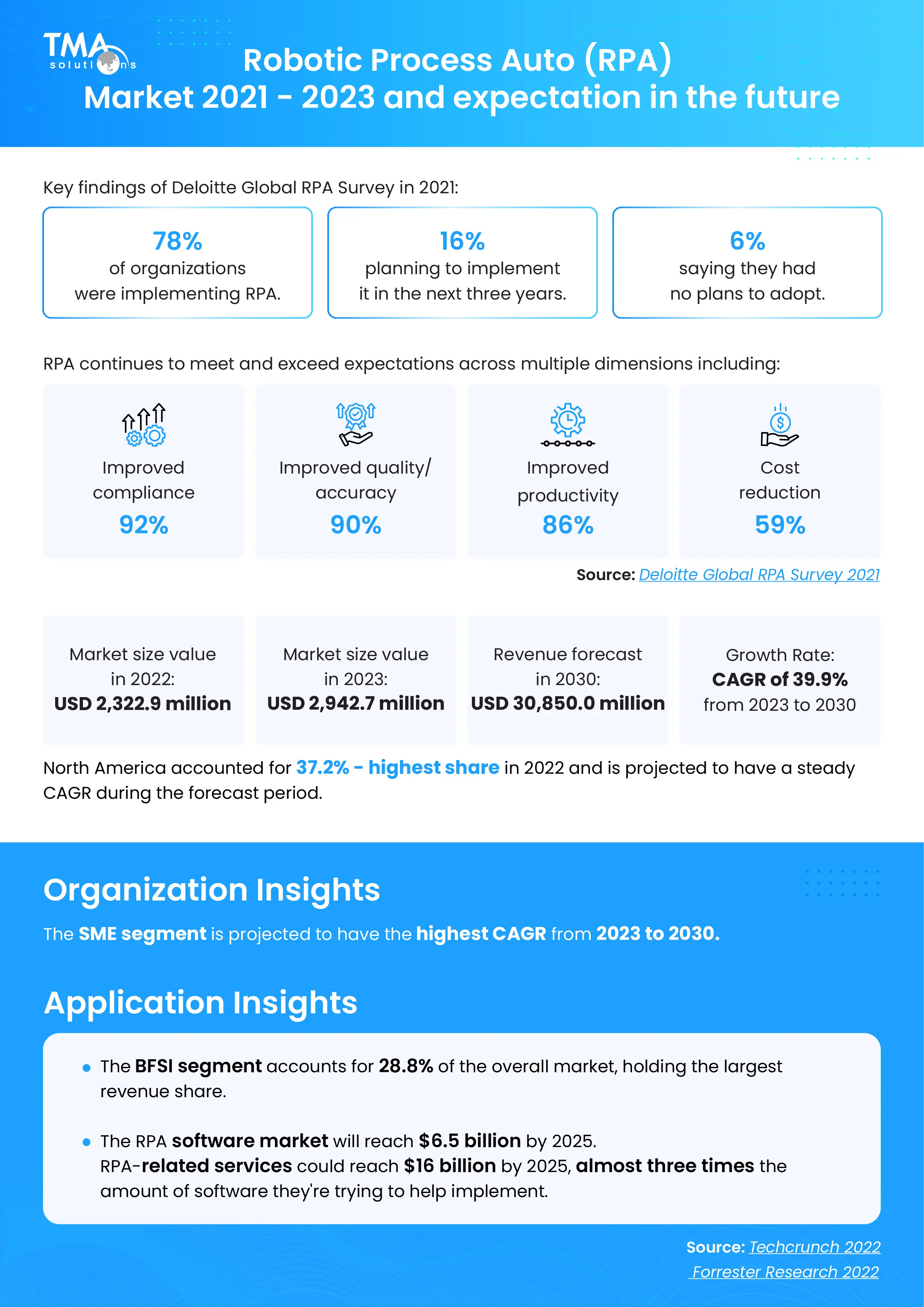
The implementation of RPA has become a strategic priority for many organizations. According to Deloitte’s Global RPA Survey conducted in 2021, a substantial 78% of organizations had already implemented RPA within their operations. Another 16% were planning to adopt RPA within the next three years, while only 6% of organizations had no plans to integrate RPA into their processes. These statistics underscore the growing recognition of RPA as a critical tool for enhancing operational efficiency and achieving competitive advantage.
The Impact of RPA on Business Operations
RPA has demonstrated its value across multiple dimensions of business operations, consistently meeting and often exceeding expectations. The following are some of the key benefits that organizations have reported:
- Improved Compliance: 92% of organizations reported enhanced compliance as a result of implementing RPA. By automating routine tasks, RPA helps ensure that processes are carried out consistently and in accordance with regulatory requirements.
- Enhanced Quality and Accuracy: 90% of businesses experienced improvements in the quality and accuracy of their operations. Automation reduces the risk of human error, leading to more reliable and precise outcomes.
- Increased Productivity: 86% of organizations noted a significant boost in productivity. RPA enables businesses to automate repetitive tasks, allowing employees to focus on higher-value activities that require human judgment and creativity.
- Cost Reduction: 59% of companies reported cost savings through the use of RPA. By streamlining processes and reducing the need for manual intervention, organizations can lower operational costs and improve their bottom line.
Market Size and Growth Projections
The RPA market has seen impressive growth, with significant increases in market size year over year. In 2022, the RPA market was valued at USD 2,322.9 million. By 2023, this figure had risen to USD 2,942.7 million, reflecting the strong demand for automation solutions. Looking ahead, the market is expected to continue its rapid expansion, with a projected compound annual growth rate (CAGR) of 39.9% from 2023 to 2030. By 2030, the RPA market is forecasted to reach an astounding USD 30,850.0 million.
Regional and Industry Insights
RPA adoption varies across regions and industries, with some areas leading the charge in embracing automation technologies:
- North America: This region accounted for the largest share of the RPA market in 2022, representing 37.2% of the global market. North America is expected to maintain steady growth during the forecast period, driven by the continued adoption of RPA across various sectors.
- Small and Medium Enterprises (SMEs): The SME segment is projected to experience the highest CAGR from 2023 to 2030. As SMEs increasingly recognize the benefits of automation, RPA solutions are becoming more accessible and tailored to the needs of smaller organizations.
Banking, Financial Services, and Insurance (BFSI): The BFSI sector holds the largest revenue share of the RPA market, accounting for 28.8% of the overall market. This industry has been a pioneer in adopting RPA to automate routine processes, enhance client service, and ensure regulatory compliance.
Future Expectations for the RPA Market
The future of the RPA market is bright, with significant growth expected in both software and related services. By 2025, the RPA software market is anticipated to reach USD 6.5 billion. In addition to software, RPA-related services are projected to grow even more rapidly, potentially reaching USD 16 billion by 2025. These services, which include consulting, implementation, and support, are essential for organizations looking to successfully integrate RPA into their operations.
TMA Solutions: A Global Leader in RPA
TMA Solutions, with its strong presence in international markets across North America, Europe, and Asia, is well-positioned to capitalize on the growing demand for RPA solutions. With a large team of over 4,000 software engineers, TMA has the scale and technical capability to handle large and complex projects. The company’s expertise spans a wide range of cutting-edge technologies, including Artificial Intelligence (AI), Internet of Things (IoT), Big Data, Cloud Computing, and Blockchain, making them a key player in the global RPA market.
Conclusion
As organizations continue to seek ways to improve efficiency and reduce costs, the adoption of RPA is expected to accelerate. The market’s rapid growth, coupled with the increasing accessibility of automation solutions, suggests that RPA will become an integral part of business operations across industries. Companies like TMA Solutions, with their global reach and technical expertise, are poised to lead the way in delivering innovative RPA solutions that meet the evolving needs of businesses worldwide.

Latest News
.webp_2025-12-01-15-17-04-854.webp)


Start your project today!
Share: